The Flavors of Tet in Hanoi: A Guide to 4 Bowls & 4 Plates
Written by: Taylor Holmes
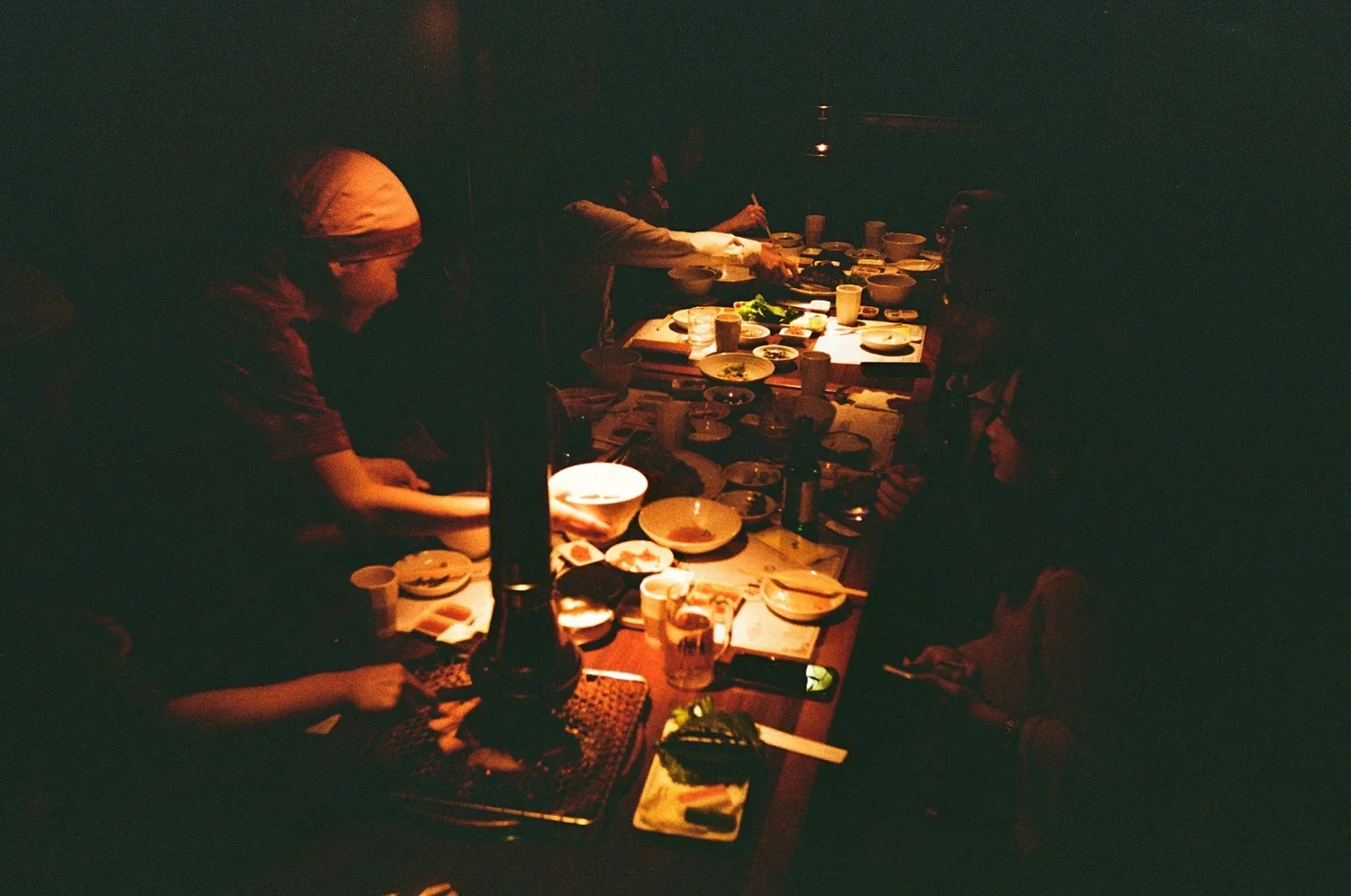
Proof that the best spice for any Tet meal is a crowded table and at least three conversations happening at once.
As the fine, misty drizzle known as mưa xuân settles over the moss-covered tiles of the Old Quarter, a peculiar transformation takes hold during Tet in Hanoi. The frantic honking of motorbikes yields to the fragrant, heavy scent of boiling Bánh Chưng and the sharp, clean aroma of coriander-infused baths. In the capital, Tet isn't just a date on a lunar calendar; it is a sensory marathon. To eat your way through a Hanoi food during the new year is to taste centuries of history preserved in a single bowl of jellied meat or a cup of lotus tea. It is a time when the kitchen becomes a sanctuary, and every ingredient, from the crunch of a pickled onion to the emerald hue of sticky rice, is a quiet prayer for luck, lineage, and the lingering warmth of home. Today we’ll dive into “what is the 4 bowls 4 plates rule?”, the meaning of five elements in a Tet meal, and the history of Bánh Chưng in Northern Vietnam.
The Ultimate Guide to Hanoi’s Tet Holiday Specialties
The Flavours of Tet
These days, the world comes at you faster than ever before. Life comes and goes in the blink of an eye, and the fast-paced living in Hanoi is no different. It’s never been more important to take the time to slow down and enjoy the sights, sounds, smells, and most importantly, tastes that life has to offer. Tet is the perfect time to stop and smell the incense, and spend some time with the people who matter to you.
No matter how you spend your Tet in Hanoi, the food is a critical aspect. Let’s dive in and uncover the wonderous food scene that is a Hanoian Tet!
The Soul of the Meal: Bánh Chưng
If Tet had a flavor, it would be the earthiness of mung bean and fatty pork wrapped in leaf-stained sticky rice. This traditional dish really captures the essence of Tet and family gatherings (not to mention full bellies)!
The Significance: Unlike the cylindrical Bánh Tét of the South, Hanoi’s Bánh Chưng is square, representing the Earth (based on the legend of Prince Lang Lieu). It symbolizes gratitude to ancestors and the land.
The Culinary Nuance: In Hanoi, the rice is often soaked with galangal leaf juice to give it a deep emerald green color. It is traditionally boiled for 10–12 hours over an outdoor wood fire, a communal ritual that is as much about the vibe as it is about the cooking.
Chef’s Tip: Got leftover Bánh Chưng? Slowly fry the sides in a pan with a bit of oil to give a whole new depth and crunch! You can even mash it up in the pan to make a fried rice!
The "No-Knife" Rule:
In many traditional Hanoi homes, it is considered bad luck to use a knife to cut the Bánh Chưng. Instead, the bamboo strings (lạt) used to wrap the cake are used as wires to slice it into eight perfect, clean triangles.
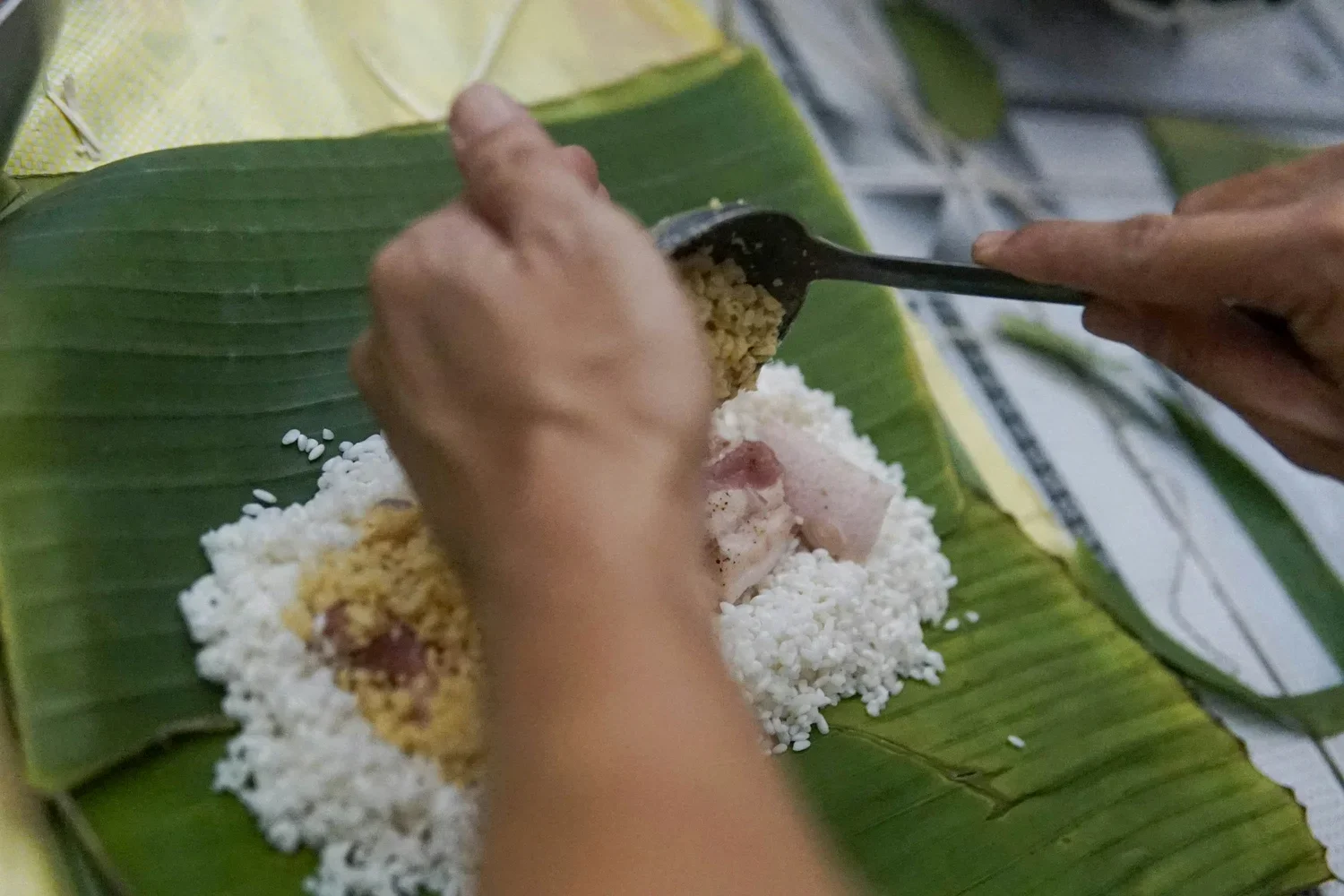
The ultimate culinary architecture. No blueprints required, just generations of muscle memory and a lot of patience!
The Delicate Essentials: Thit Đông & Dưa Hành
Hanoi Tet food is designed for the Northern winter. Plenty of foreign tourists find themselves shocked at how cold the damp 10°C air can really feel! these accoutrements make perfect pairings for your bánh chưng!
Thịt Đông (Jellied Meat): This is a quintessentially Northern dish. Made from pork skin, shank, and wood-ear mushrooms, the natural collagen creates a clear jelly in the cold weather. It represents transparency and a smooth start to the year.
Dưa Hành (Pickled Onions): You can’t have the richness of fatty meat without the crunch of fermented onions. There’s an old Vietnamese saying: "Fatty meat, pickled onions, red couplets." It’s the ultimate palate cleanser and a nod to the balance of Yin and Yang.
Giò Lụa (Pork Sausage): An honourable mention. While more common in the south, the smooth and mellow flavours of the lean pork accompany the other dishes perfectly.
Chef’s Tip: The pungent yet delicate umami of fish sauce can really tie these dishes to your bánh chưng artfully!
The Luck Soup: Canh Bóng Thả
This is where Hanoian culinary sophistication really shines. A perfect way to warm the bones on a cool Hanoian spring day! It’s a colorful, clear soup made with:
Dried pig skin (puffed up like a sponge).
Dried shrimp, broccoli, carrots, peas, mushrooms, minced pork meatballs, or (optionally) fishballs may all be found in this delicious brothy soup.
Significance: The bowl looks like a vibrant garden in spring. It represents the hope for a colorful, flourishing year ahead. Historically, it was a test of a Hanoian woman's "Khéo tay" (dexterity/skill), as the vegetables are often intricately carved into flowers.
Chef’s Tip: For this soup, layout is everything. Create a beautiful display, then gently pour just enough broth over to cover the contents before garnishing. A work of art in a bowl!
The Sweet & Social: Mứt Tết & Lotus Tea
The Silent Tea:
Traditional Hanoi Lotus Tea is often scented by placing high-quality green tea inside a living lotus flower at night, then tying the petals shut so the tea "breathes" the aroma overnight. It’s known as the most expensive and sophisticated tea in Vietnam.
Tet isn't just about the main meals; it’s about the grazing done while hosting guests. It’s as much about the social aspect as it is about filling your gullet!
Mứt (Candied Fruits): Traditional trays feature candied ginger (for warmth), coconut (for togetherness), and lotus seeds.
Hanoi Lotus Tea: This isn't just tea; it’s a craft. High-end Hanoi families traditionally used tea scented in West Lake lotus blossoms. It is the drink of choice for welcoming neighbors, meant to facilitate slow, meaningful conversation.
Chef’s Tip: Often, you’ll find an array of beverages available. From tea, juice, and beer to red wine (have a glass, for luck!). This chef’s tip is to drink in moderation. No one wants to usher in the new year with a wicked hangover!
"4 Bowls, 4 Plates" rule (4 Bát, 4 Đĩa)
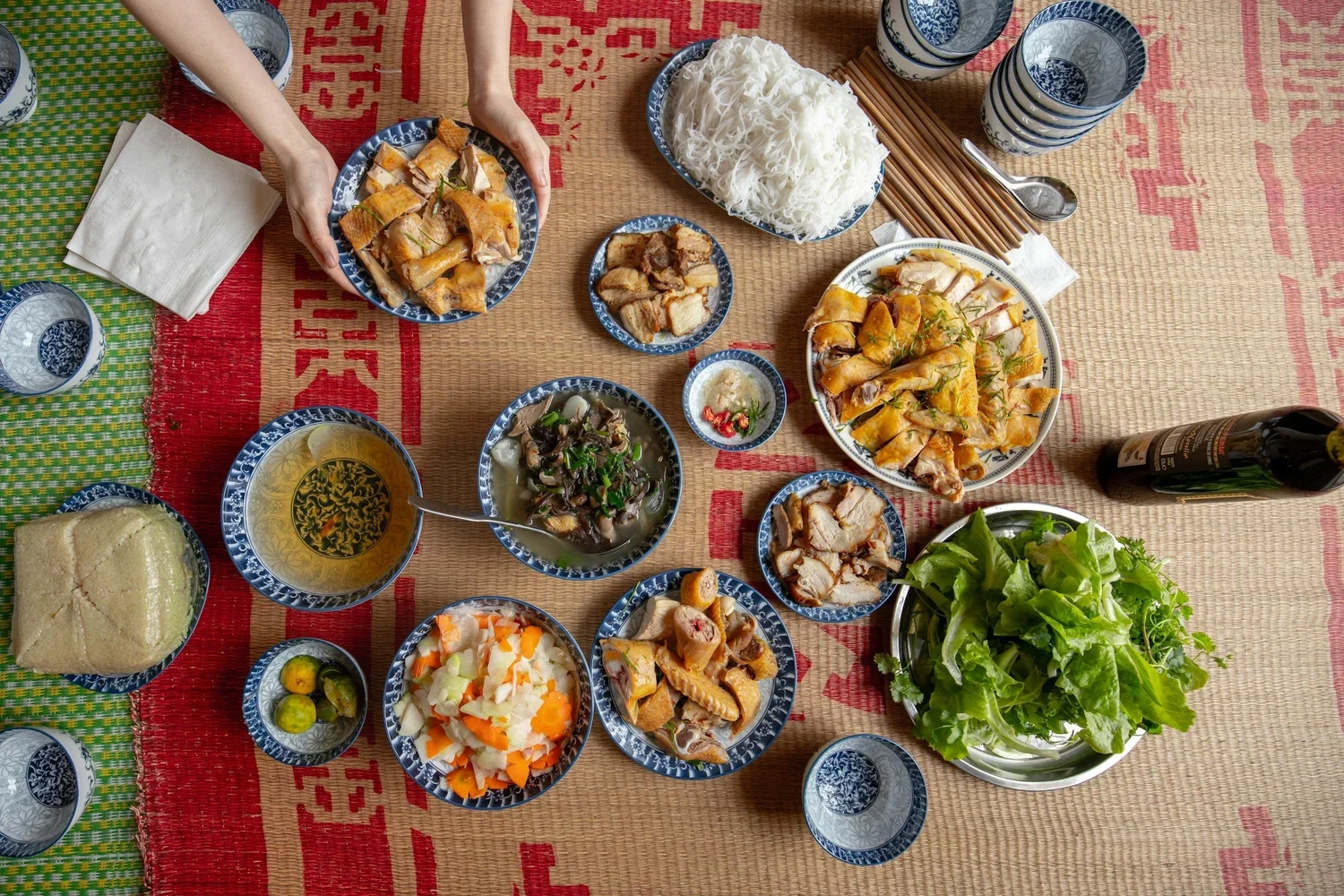
Table for ten, or just one very ambitious foodie? In Hanoi, the Tet spread is as much a feast for the eyes as it is for the soul.
In the refined households of Hanoi, the Tet feast isn't just a meal, it’s an architectural feat governed by the "4 Bowls, 4 Plates" rule (4 bát, 4 đĩa). For wealthier or more traditional families, this can even scale up to 6 or 8, but the core remains a symbol of balance, prosperity, and the four cardinal directions.
Here is the breakdown of this traditional layout to help you visualize the table:
The 4 Bowls (4 Bát): The Foundation of Warmth
The bowls are usually placed at the corners. They represent the "liquid" element, essential for the cold Northern winter.
Canh Bóng Thả (Dried Pig Skin Soup): As mentioned, this is the garden of the tray. The pig skin is prepared so it’s porous and light, absorbing the rich broth of dried shrimp and broccoli.
Canh Măng (Bamboo Shoot Soup): Usually cooked with dried bamboo shoots and pig’s feet. The bamboo must be soaked for days and boiled multiple times, representing patience and resilience.
Canh Miến (Glass Noodle Soup): A clear, delicate soup made with chicken broth, wood-ear mushrooms, and often topped with sliced gizzards. It represents longevity through the long, unbroken strands of noodles.
Canh Mọc (Mushroom & Meatball Soup): Small, springy pork meatballs (often stuffed into shiitake mushroom caps) floating in a savory broth.
The "4 Plates" (4 Đĩa): The Substance of Prosperity
The plates are the centerpiece, showcasing the variety of textures and colors available in the spring.
A Bath for the Soul:
On New Year’s Eve, Hanoians traditionally bathe in water boiled with Old Coriander (Mùi Già). The spicy, earthy scent is believed to wash away the misfortunes and "dust" of the old year, leaving you fresh for the new one.
Bánh Chưng: The aforementioned anchor of the meal. In a formal setting, it is never cut with a knife, but stripped into eight perfect triangles using the very bamboo strings used to wrap the cake.
Gà Luộc (Boiled Chicken): Not just any chicken, it must be a whole rooster, boiled to a glistening golden yellow. A small dish of salt and sliced lime leaves is always served alongside it for dipping.
Giò Lụa (Vietnamese Ham/Sausage): The slices of smooth, lean pork sausage are arranged in a circle. It represents a "smooth and easy" year ahead.
Thịt Đông (Jellied Meat) OR Nộm (Salad): While Thịt Đông is a staple, many families swap the fourth plate for a crunchy Nộm (kohlrabi or papaya salad) to cut through the richness of the other dishes.
Last but not least, we have the Xôi Gấc (Red Sticky Rice). No Hanoian Tet tray is complete without the vivid crimson of Xôi Gấc. Naturally colored using the seeds of the baby jackfruit, it is synonymous with good fortune and prosperity in Vietnamese culture (due to the red colour). It is traditionally placed at the center of the table to invite luck into the home for the coming year.
The Symbolism of the Layout
In Hanoian culture, the arrangement is a microcosm of the universe. Each piece plays a pivotal allegorical role.
| Element | Colour | Tet Dish | Symbolism |
|---|---|---|---|
| Wood | Green | Bánh Chưng | Growth & Vitality |
| Fire | Red | Xôi Gấc | Luck & Energy |
| Earth | Yellow | Gà Luộc | Roots & Stability |
| Metal | White | Dưa Hành | Purity |
| Water | Black | Nấm Hương | Wisdom |
The Colours: Green (rice), Red (sticky rice with baby jackfruit), Yellow (chicken), White (onions), and Black/Dark (mushrooms) represent the Five Elements (Wu Xing).
The Symmetry: The balance of bowls and plates ensures that the "Yin" (liquid/soup) and "Yang" (solid/meat) are in perfect harmony, inviting peace into the home for the coming year.
An important note is that the porcelain and dishware are almost as significant as the dishes themselves. This is the time of year to showcase the Bat Trang ceramics (the good stuff), to show the highest honour and respect for guests and ancestors.
The Takeaway: The Quiet Geometry of a Hanoian Spring
As the last savory bite of Bánh Chưng is cleared and the tea leaves settle at the bottom of a Bat Trang ceramic cup, one realizes that the 4 bowls and 4 plates of a Hanoi Tet are more than just a culinary tradition. They are a quiet geometry of the heart and soul, a way for families to map out their gratitude for the year passed and their hopes for the one to come.
In a city that is modernizing at breakneck speed, where coffee shops replace ancient tea stalls and skyscrapers cast shadow over the narrow alleys of the Old Quarter, these flavours remain the city’s tether to its soul. To sit at a Hanoian table during Tet is to understand that home isn’t just a place; it is the specific crunch of a pickled onion, the warmth of a ginger candy, and the shared steam of a soup bowl that has tasted the same for generations. In the bite of the Northern winter, Hanoi doesn't just feed the body, it warms the spirit, one meticulously crafted plate at a time.
Itching for more of Southeast Asia? Read up on our take on Chiang Mai!
Excited for your aunt to ask why you’re still single? Or your grandma to ask where the grandchildren are? Leave a comment and share more fun facts for the holidays to keep the relatives at bay!
