Ares: The God Who Bled | Why History Was Wrong About the God of War
Written by: Taylor Holmes
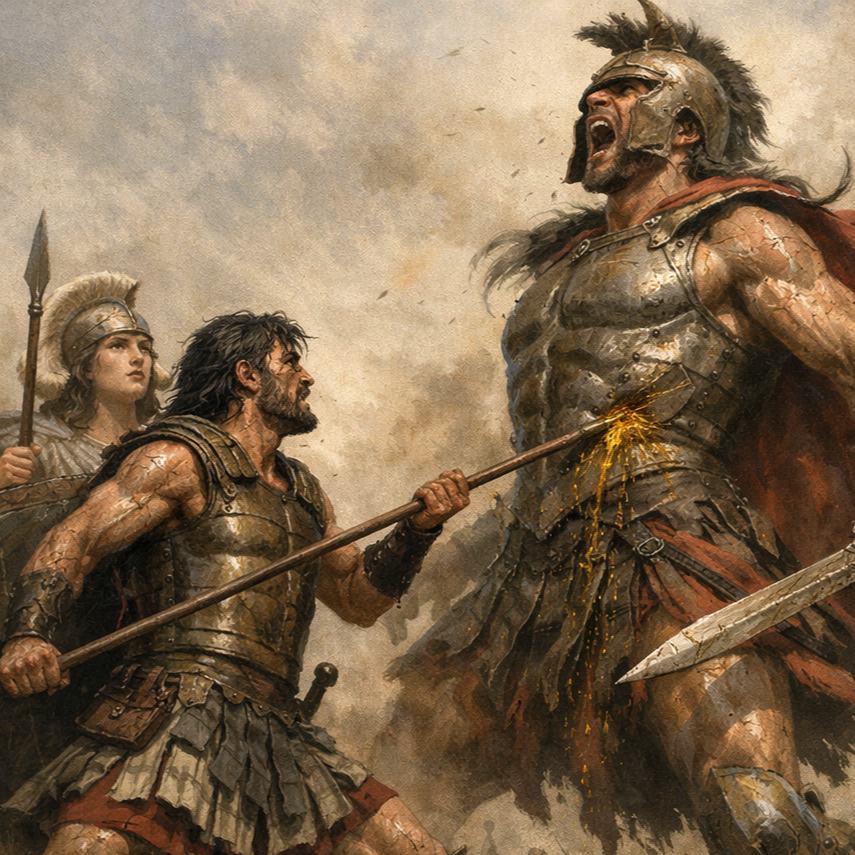
Diomedes, guided by Athena, wounds Ares in Homer’s Iliad. Seems fair.
History is written by the victors, in the case of Greek Mythology, it was largely written by the Athenians. They gave us philosophy, democracy, and a very specific version of the gods, one where their patron, Athena, was the golden child, and her brother Ares was the bumbling villain. But if you look past the propaganda, you find a god who was more human, more loyal, and more decent than the rest of Mount Olympus combined.
The God Who Bled: Why History Was Wrong About Ares
Ares. Truly the most loathsome of the Greek Pantheon. Who else would drive Ajax, the Greek’s strongest remaining warrior in the wake of Troy’s fall to madness and suicide for feeling betrayed after being passed over for Odysseus? Oh, right. That was Athena. Certainly it was Ares who beat a talented young Arachne, destroyed her flawless weavings, and cursed her (and her descendants) to live as sub-humans for taking pride in her work! Wait, no. Athena, again. Surely, surely, it was Ares who struck a man blind for accidentally seeing him bathe! Damnit… Athena really was cruel, wasn’t she?
And yet, which God of War do we associate with abject cruelty, merciless punishment, and wanton destruction? Ares. The only god to faithfully put his role as a father ahead of that of a deity. Seems fair. Athena held capital over the realm of justice and sanctioned violence, rather than her nemesis, who presided over the realm of bloodlust and carnage on the battlefield. He more likely held domain over murder than justice! Oof, that was the Phonoi.
It seems fitting when you consider whose accounts of history and mythology we rely on: those of Athens. There’s no way they could possibly be biased against Ares, who was diametrically opposed to their eponymous goddess of Wisdom and Strategy (who totally always bested Ares, right???).
Well, enough sarcasm. I’m about to borrow from Athena and bring some sanctioned violence unto the Athenian propaganda and character assassination of Ares.
Who was Ares?
To be so presumptuous as to give a fair and unbiased review of a Greek God is hubris enough to turn me (and my lineage) into spider creatures, right Athena? To truly measure a man’s worth, we must look at his deeds. To measure the worth of a god? Well now. That is a task. Fortunately, Ares makes it easy. He is the ugly, naked truth of war. He doesn’t hide the truth of his domain behind flowery words, beautiful visages, or deceit. In a nutshell, Ares is honest.
While the Greek Pantheon was riddled with careless disregard of mortal lives, frequent acts of sexual violence, uncaring/illegitimate parenthood, and unfaithful lovers, Ares was different. Sure, he viewed a mortals life as no more valuable than a breath of air, but that was on the battlefield. A place where life was intended to be judged by prowess and survival of the fittest. Off the battlefield was a different story…
Don’t misunderstand my position. I have no intention of misrepresenting Ares as a kind or fair god, merely I seek to expose the truth of his character in contrast to his peers. You must have some flaws if your dad (Zeus) tells you that you are the most hateful of the gods for “loving” only “strife, war, and battle…” but to be fair, he probably went and tricked a woman into bed shortly after. How’s that for “love”? But his father was wrong (where’s my lightning rod?) Ares loved more than strife, war, and battle.
The Trial of the Areopagus: The First "Bodyguard"
Unlike many of his peers, Ares wasn’t known for slaughter off the battlefield. In fact, it was seldom that it occurred, and when it did, it was at least understandable. Hell, when a favourite pet of his (the Ismenian Dragon) was killed by Cadmus, founder of Thebes, Ares elected only to punish him with 8 years of slavery. Remarkably merciful for a Greek God.
In fact, one of the few cases of Ares slaughtering off the battlefield is when he slew Halirrhothius, son of Poseidon. Why? Well, old Hali tried to force himself on Ares’ daughter, Alcippe. An arguably just and reasonable reaction. The fallout for killing such a predator? The first ever trial of a god. Eventually, he was acquitted for the killing. This famous trial lead to the hill being named for the event; Areopagus (hill of Ares).
This example is a testament to Ares’ position as an outcast among the gods. In a mythology filled with deities who ignored or enabled assault, Ares was the only one to face a jury of his peers to defend the dignity of a woman.
His other more well-known slaughter was that of Adonis. Ares, in the form of a boar, gored the sexy young man during a hunt for hogging all of Aphrodite’s affections. Unlike his father, he didn’t change shape to hide his crime or deceive his peers, he simply donned his wrath as the force of nature he was.
The Consensual Lover: Ares and Aphrodite

Mars and Venus (Ares and Aphrodite) by Sandro Botticelli, 1483. A little less ‘fit’ than I expected.
On the never-ending litany of sexually predatory Greek Gods, you’ll find one name constantly missing: Ares. While his relationship with Aphrodite was one of scandal (she was the wife of his brother, Hephaestus), it was by all accounts one of consent. While Zeus used disguises and Poseidon used force, Ares and Aphrodite’s affair was rooted in raw passion and mutual affection.
Life for Aphrodite must have been difficult. While always the beauty, she remained the coveted object of male desire everywhere. Somewhere along the lines, it must be difficult to be seen only as a sexual object, no matter how flattering it may feel. Ares was often depicted as the only male god who actually listened to Aphrodite. In the Iliad, when Aphrodite is wounded, it is Ares who comforts her and lends her his chariot. He treats her as an equal, not a trophy.
While he may not have been chivalrous, Ares had a sense of decency with the fairer sex that most of his Olympian male peers (barring maybe Hades) lacked. Ares has no record of indecency with women, and no history of non-consensual relations.
No Deadbeat Dad
While his own father, Zeus, proved a poor role model for fatherhood, Ares was one of the few to take care of his offspring. Not just in protecting and avenging their honour, like in the case of Alcippe.
Ares was the patron and father of the Amazons. He gave them strength and independence, standing as the divine patriarch of a society of empowered women. Not only did he actively support their queens, he legitimately sired the Amazons with his consort, Otrera. It’s no wonder war ran through their veins.
When his son Cycnus (a ruthless bandit) was slain by Heracles, Ares flew into a fit of rage. Were it not for the wrath of Zeus, Ares would have inflicted immense retribution for his son’s death. A similar case occurred with the death of his son Ascalaphus. Once again, Ares, bent on vengeance was only contained by the wrath of Zeus and the restraints of Athena. Even if grandpa never cared, at least daddy did, right?
The Honesty of War
Ruthless, savage, and abrasive as he is, Ares was anything but dishonest. Never did he hide who he was (even in the slaughter of Adonis), never did he shy away from his fury (as seen in the deaths and violations of his offspring), nor did he fail to take advantage of his moments off of the battlefield (his passionate love affairs). He is absolutely an all-in kind of god.
Every time he faced bitter defeat or humiliation, it was due to the subterfuge or underhanded techniques of other gods (usually Athena). The myths of the Bronze Jar or the wounding by Diomedes in the Iliad weren't objective records; they were the ancient equivalent of political cartoons. By portraying the raw, terrifying power of War as a bumbling, weeping fool, the Greeks were trying to laugh away their own very real fear of the carnage he represented.
In the Iliad, when Ares is wounded by Diomedes and screams, the Greeks mocked him for his "un-godly" reaction. Ares doesn't represent the glory of the general; he represents the agony of the infantry. If war is painful, why should the God of War be immune to it? His scream isn't cowardice, it’s the collective cry of every soldier on the field.
While Athenians painted him as a mindless brute, they hide a god who fought for his family’s honor. Where they portray him as the “loser” of the Iliad, they demean the god who felt the actual pain of the spear’s-tip. When they praise the other unfaithful adulterers and sex-criminals of the pantheon, they betray the name of one of the most long-term devoted partners in the mythos. Finally, while they slander him as a threat to order, they ignore the father who established the first court of law for murder, the eponymous Areopagus.
The Takeaway
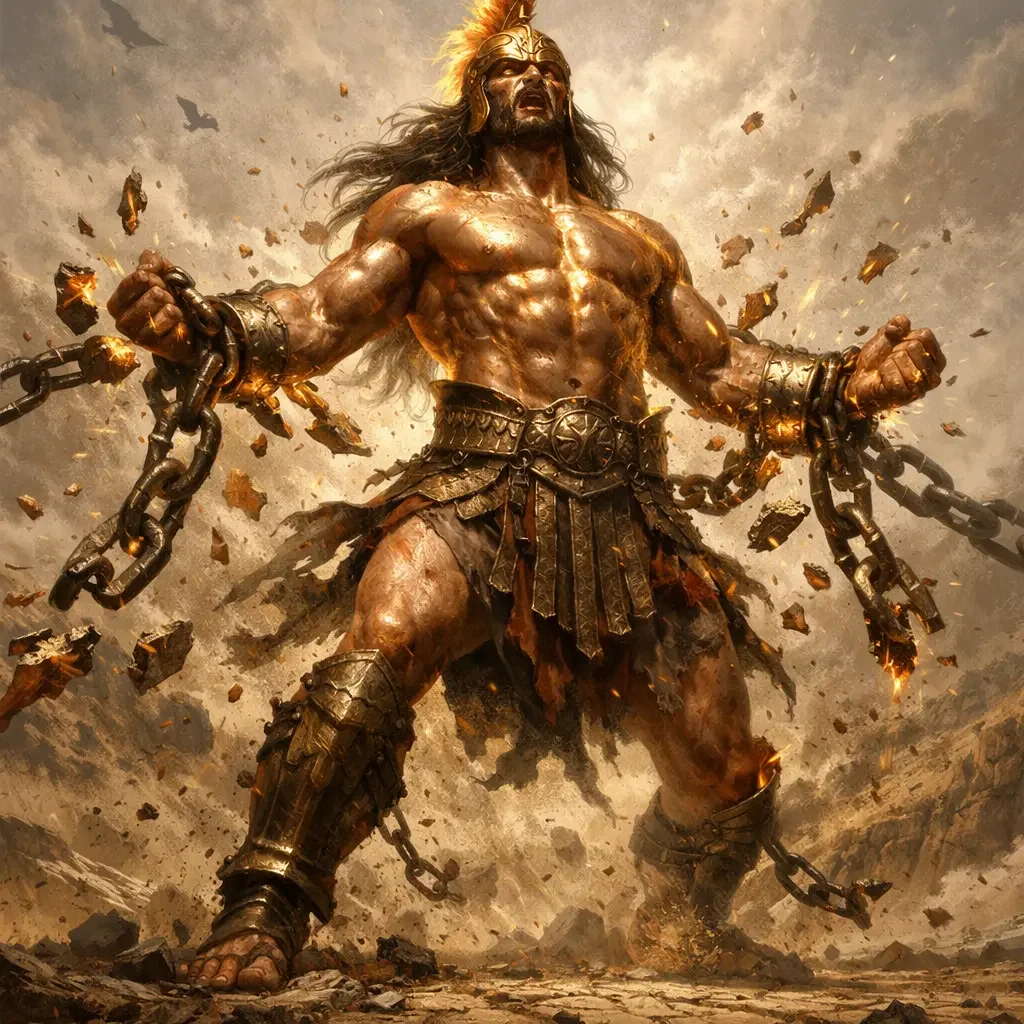
Ares breaking free from bronze restraints. A mythological depiction of war’s divine return in the ancient Aegean world.
We are taught to laugh at Ares. We laugh when he is caught in Hephaestus’s net, and we sneer when he fled the battlefield of Troy in tears. But look closer at his rivals. Athena represents the war we wish existed: clean, tactical, and cerebral. Ares represents the war that actually exists: messy, heartbreaking, and agonizingly physical. Ares is the only Olympian who doesn't look down on the dying soldier from a distance; he is the only one who feels the spear’s-tip. His “weakness” is, in fact, his greatest mercy… He is the only god who shares our pain.
Truly, a more compelling character assassination could not have been committed. I can only hope that one may think twice about how the victors of history write our stories. Who knows how we’ll be portrayed?
-
Homer, The Iliad, Book 5
The Homeric Hymn to Ares (Hymn 8)
Apollodorus, The Library, Book 3.14.2
Hesiod, Theogony
-
“Ares: The Unknown God" by Matthew Dillon (2002)
"The Gods of the Greeks" by Erika Simon
"The Justice of Zeus" by Hugh Lloyd-Jones
Got beef with Ares? Are you an Athena-apologist? Maybe you read the Iliad, and think he’s a wussy? Leave a comment below, and let’s go to war!
