How to Buy a Bike in Vietnam (as a Foreigner)
In This Article
Stepping onto the pavement of Hanoi or Ho Chi Minh City for the first time is a sensory baptism. At a glance: lanes mean nothing, scooters and bikes dominate the roads (and sidewalks) while carrying anything and everything on their narrow tails, and there’s more honking than a clown at a goose’s birthday party (my cat certainly wasn’t a fan).
To the uninitiated, it looks like absolute madness. To the locals, you quickly realize that riding a bike isn't just convenient, it’s damn near mandatory. When traffic is dense and anything could get in your way (from pedestrians to coach busses), you’ll need to slip through every narrow space you can. That’s not to mention the winding alleys.
But the transition from a pedestrian to a rider requires navigating an absolute minefield of bad internet advice, outdated legal myths, and used-market scams. This is a first-hand led, field-tested guide to buying a bike and decoding the paperwork.
The Engine Choice: 50cc vs. 110cc+ (The License Trap)
The very first choice you face is engine displacement, and this decision is entirely tied to your legal liability at local police checkpoints. It could be the biggest thorn in the side of your ride to Ha Long Bay, or a non-issue altogether.
The 50cc Route (Zero Friction)
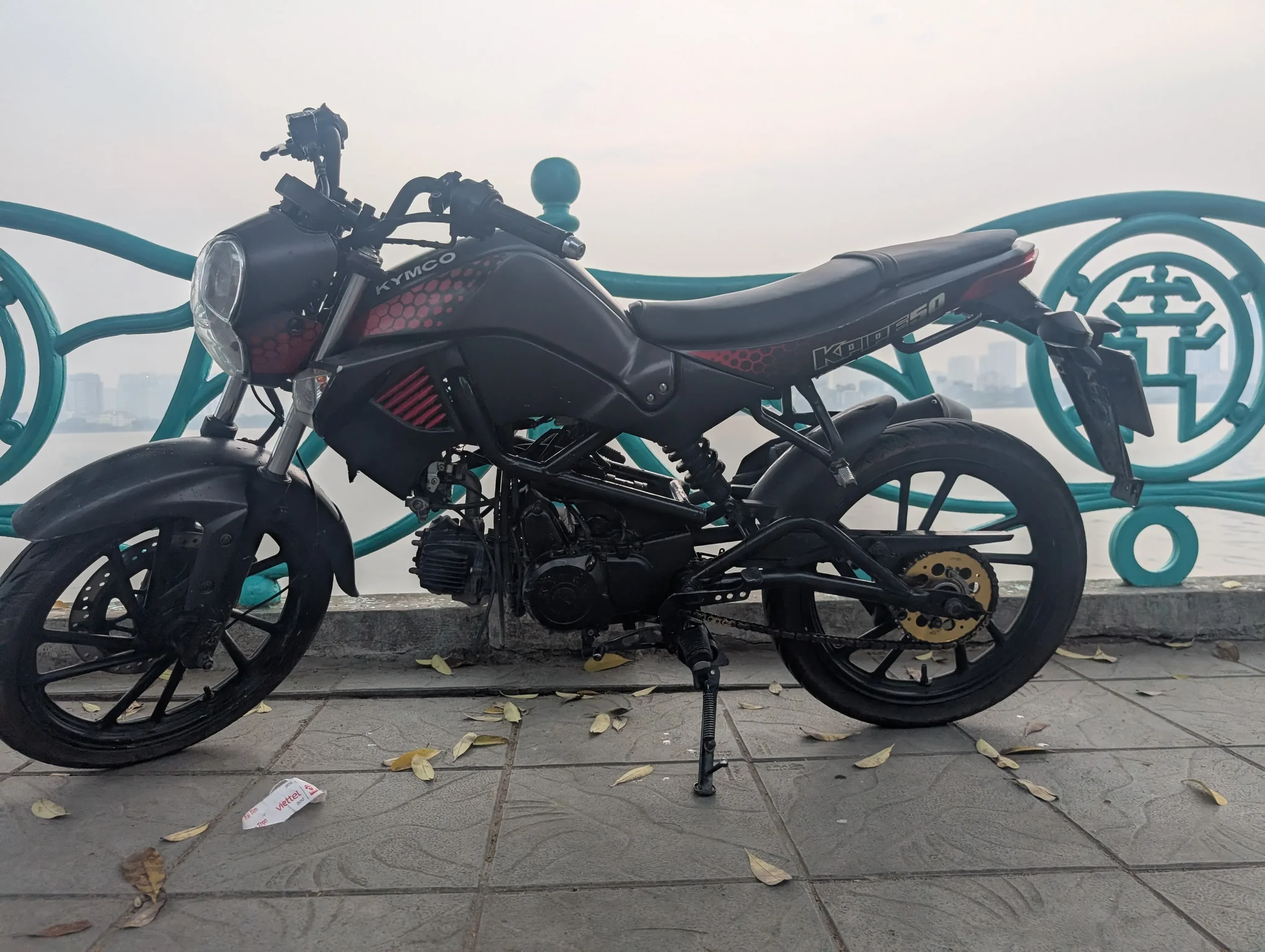
My bike, Kymchi. The lightweight, exposed-frame Kymco K-Pipe 50cc is an excellent, license-free option for navigating the dense traffic of Hanoi. It doesn’t hurt that it looks cool too.
If you want to ride completely legally without the bureaucratic nightmare of converting a foreign motorcycle license, the 50cc class is the holy grail. Under Vietnamese law, anyone can ride a vehicle with a displacement below 50cc using a standard automobile license or no license at all. It’s the saving grace for students and foreigners alike.
The Bikes: Look for timeless classics like the Honda Cub (semi automatic) for underbone style, Vespa clones (fully automatic) step through style, or lightweight backbone bikes like the Kymco K-Pipe 50 (semi automatic)and the Honda 67 (manual).
The Reality: They won't win you any drag races, but in dense city traffic where the average speed rarely breaks 30 km/h, a 50cc machine is more than enough to split lanes and get you anywhere you need to go, all while inching past that bloodthirsty bus driver.
The 110cc–150cc Route (The Commuter Standards)
This class comprises the backbone of Vietnam: semi-automatics like the ubiquitous Honda Wave or Honda Future, and full automatics like the Yamaha NVX or Honda AirBlade.
The Catch: Legally riding anything over 50cc requires a local A1 motorcycle license or a perfectly valid International Driving Permit (IDP) explicitly showing a motorcycle endorsement. Local transit police (Cảnh sát giao thông) actively run checkpoints, and riding dirty means risking a steep fine and/or having your bike impounded on the spot.
The Paperwork Labyrinth: Decoding the Myth of Ownership
When buying a used bike in Vietnam, you will hear one phrase repeated constantly: Cà Vẹt (the Blue Card). This tiny laminated slip of blue paper is the literal soul of the vehicle. If a seller cannot hand you a physical Blue Card, walk away instantly. You are probably looking at a stolen or illegally imported machine that the police can and will seize without hesitation.
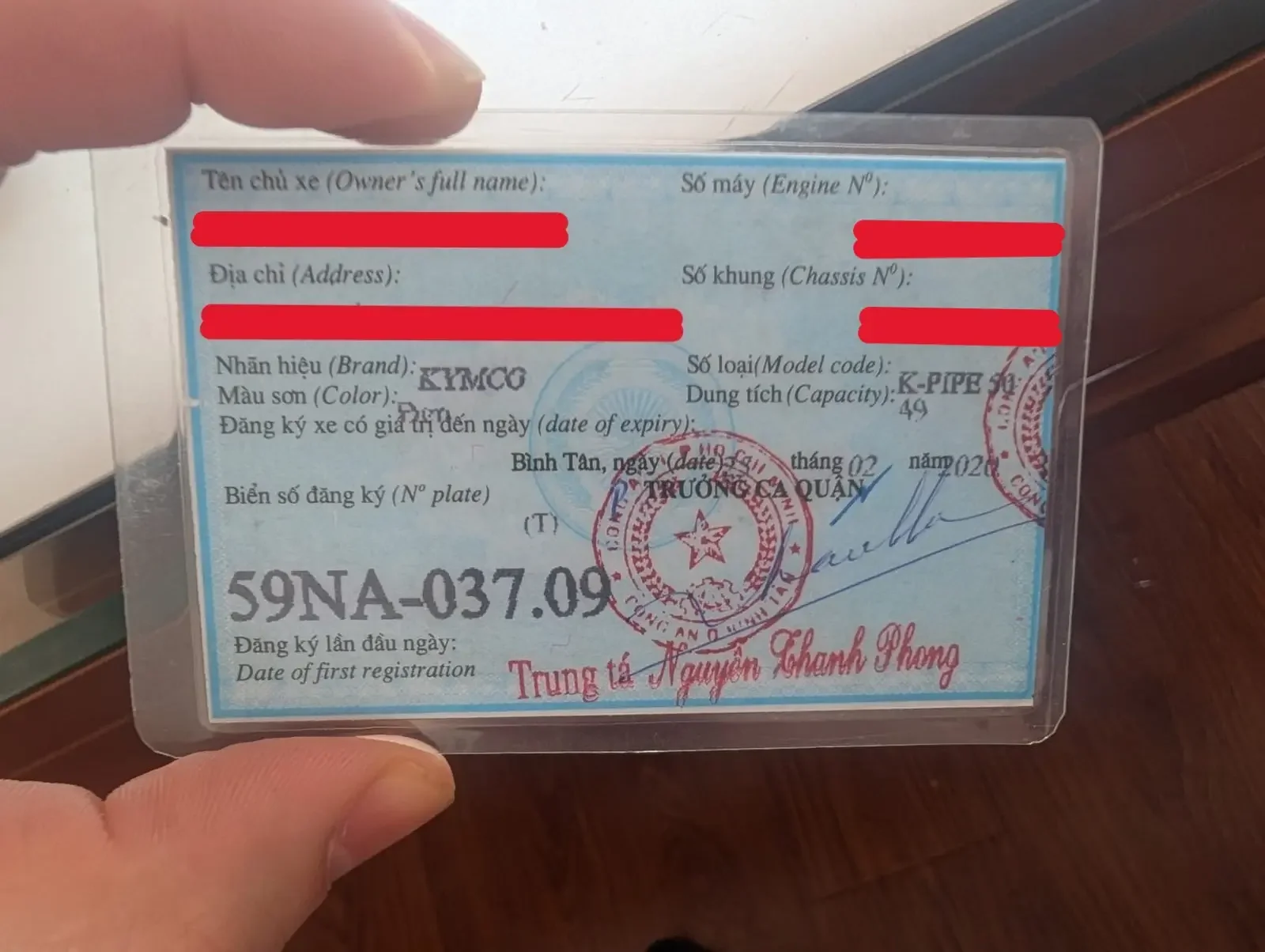
What a legitimate Blue Card should look like (barring the censored information).
Aside from the Blue Card, the most important piece of paperwork (or QR, as it may be) you could have is the CTPL, or Compulsory Civil Liability Insurance. This insurance helps cover any damage to property, vehicles, or people, caused by the bike’s rider. It is specific to the vehicle itself, and while cheap (less than 100,000 VND annually) and fairly easy to obtain, its absence can be a great excuse to get slapped with a fine by the police.
The Blue Card must:
Match the license plate, frame, and engine numbers
Validate the bike’s legal existence (that it has been registered)
Bear the owner (or previous owner’s) name
The "Chính Chủ" (Original Owner) Misconception
Westerners often panic when they look at a Blue Card and see a local Vietnamese name that doesn't match the person currently selling the bike. Don't stress. In the budget used market, it is completely standard for a bike's paperwork to stay tied to the original owner three links back in the chain.
Local authorities care that the physical card exists and perfectly matches the stamped numbers on the bike's chassis and engine block. They do not care if your passport name matches the print on the card.
The City Tag Premium
Pro-Tip for 2026/2027:
Keep in mind that Vietnam is currently rolling out its first-ever mandatory vehicle emission inspection roadmap for internal combustion bikes, specifically targeting older models in Hanoi and HCMC. If you are buying an older secondhand commuter model, lean toward bikes built post-2017 to completely bypass the initial phases of infrastructure checks!
Pay very close attention to the prefix digits on the physical metal license plate, as it drastically dictates the bike's resale value and marketability (particularly with locals):
Hanoi Plates: Look for prefixes 29, 30, 31, 32, or 33.
Saigon (HCMC) Plates: Look for prefixes 50 through 59.
Northerners covet local Hanoi plates. If you try to sell a Saigon-registered bike (a 59-series plate) in the streets of Hanoi, local buyers will immediately use it as a massive bargaining chip to hit you with a steep lowball offer (often trying to drop a fair price down significantly). Why? Because cross-city ownership transfers are a bureaucratic headache for locals, but a non-issue for foreigners. If you plan to live and eventually sell your bike in Hanoi, try to buy a Hanoi plate.
Regarding the aforementioned Compulsory Civil Liability Insurance (CTPL), they can be purchased in person at many gas stations or online through companies like PVI and Liberty.
Navigating the Used Market: Spotting the Bait
Facebook Marketplace is the primary hub for bike shopping in Vietnam, but it is heavily patrolled by predatory flippers and scammers. Learn to spot the red flags:
The Placeholder Price Bait: If you see an incredibly clean, modern scooter or a highly customized tracker listed for 1,000,000 VND or 2,000,000 VND, it's a scam. Sellers use these fake floor prices to trick the Facebook algorithm and rank at the top of "lowest price" searches. When you message them, they will reveal the real price is triple that amount (at least).
The Deposit Trap: If a seller claims they’re getting flooded with offers on a “mint condition” bargain and asks you to send a quick 500,000 VND via MoMo to hold it before you visit, block them. The profile is likely a burner account created less than a year ago with an empty timeline and a series of victims.
The Filter: Skip anonymous Marketplace listings entirely if your gut feels off. Stick to trusted community boards (like Hanoi Massive, Tay Ho Expats, or Saigon Expats) where posters have established profiles and accountability.
Alternatively, you can try the site/app Chợ Tốt. It’s kinda like Vietnam’s version of ebay. The benefit is that it’s very transparent. It lists much more comprehensive details of the vehicle, price, and level of accompanying paperwork. The potential drawback is that it is absolutely and immersively Vietnamese. If you aren’t at a conversational level in writing, you’ll need a translator and patience.
The 60-Second Mechanical Audit
When you meet a seller in a public, well-lit area, skip the cosmetic scratches (inevitable) and inspect the heart of the machine:
The Top-End Check: Look closely at the horizontal cylinder head. It should be entirely dry. Any sign of weeping gaskets, caked-on dark grease, or fresh oil pooling around the casing means a costly engine rebuild is lurking in your near future.
The Factory Lines: Ensure the airbox routings, carburetor brackets, and electrical wiring harnesses look stock and tidy. Avoid bikes where wires have been haphazardly spliced or wrapped in peeling electrical tape.
Riding Dynamics: The Unspoken Rules of the Road
Forget everything you learned about defensive driving in the West. If you apply Western road logic to Southeast Asian traffic, you will cause an accident at worst, and tear out your hair in frustration at best.
The 180-Degree Rule: In the West, you monitor your blind spots constantly. In Vietnam, traffic moves like fluid dynamics. Your only responsibility is the 180-degree arc directly in front of your handlebars. You must assume that anyone behind you will react to your movements, and you must do the same for whoever is in front of you. Never make sudden, unpredictable changes in direction.
The Horn is Sonar, Not an Insult: Back home, honking is probably someone’s way of giving you the finger and being sure you know it. In Vietnam, a light tap of the horn translates to “I’m here! Don’t drift this way!” or “Coming through fast!” Use it constantly, especially when overtaking cars or rounding blind alley corners.
The Diagonal Drift: Making a left turn across oncoming traffic doesn't happen at a sharp 90-degree angle. Instead, you enter a gradual, slow diagonal drift, letting oncoming riders smoothly part around you like water around a river stone.
None of this is to say that you shouldn’t apply good driving techniques (spacial awareness, shoulder checking, etc.) but these are the rules of the road in Vietnam.
The Takeaway
Conquering the beautiful, chaotic labyrinth of Vietnam's roads takes patience, but is absolutely rewarding. It may feel stressful and chaotic, but I doubt you’ll find a driving culture that feels quite so forgiving anywhere in the west. If you’re lucky, you’ll catch an eyeful of some of the craziest cargo hauling you never knew possible!
Just keep in mind the important details. Make sure you’ve got the paperwork (Blue Card, CTPL, and proper license if driving above 50cc), the right bike for you (style and engine), and always be wary of the seller. The more transparency the better. Never hesitate to take your time, and give renting a shot so you can feel different models and really pinpoint the vibe you’re looking for.
Whether you came to Vietnam for the traditional food, the spooky wildlife, or are just touring around the Southeast Asian countries, the driving here is certainly unforgettable!
Seen some crazy freight on a tiny bike? Got a wild ride through Vietnam to share? Leave a comment below, don’t leave me idling!