The Raven King’s Ledger: Why Odin is the True Villain of the Nine Realms

Image Credit: Odin, der Göttervater (1882) by Johannes Gehrts. Source: Wikimedia Commons. Public Domain.
We’ve been conditioned by noble portrayals on the silver screen (looking at you, Sir Anthony Hopkins) and a century of Victorian-era romanticism to see Odin as the "All-Father." A wise, stern but fair, patriarch with a penchant for cryptic advice and sexy eye-patches. We see him as the noble king holding back the chaos of the frost giants and navigating the trickery of Loki.
But if you strip away the Marvel gloss and return to the blood-soaked stanzas of the Poetic Edda, a very different figure emerges. What we’re left with is no father figure, it’s a cosmic predator.
Odin doesn't want to save the world. He wants to survive it by any means necessary, and he is more than happy to use your soul as a brick in the wall of his private fortress.
The Recruitment Strategy from Hell
To understand why Odin is the true villain of the Norse mythos, you have to look at his recruitment strategy. Most gods in history offer protection in exchange for worship. Odin offers a glorified internship in an undead army. Not quite the most attractive posting on Indeed…
The All-Father title is less an endearment and more a corporate branding exercise. He needs the Einherjar, the valiant warriors fallen in battle, to fight a war he already knows he’s going to lose.
Odin was notorious for sowing discord among human kings. He didn't care for justice, that was Týr’s domain, nor did he reward the virtuous. His “rewards” were saved for the useful. If a king was winning too many battles, Odin would orchestrate his death on the battlefield simply because he wanted that leader as a general in Valhalla. He was a god of war, yes, but specifically the frenzy of war, if you wanted honour, you’d need to look elsewhere.
The Lust for Power and the Sorcery Taboo
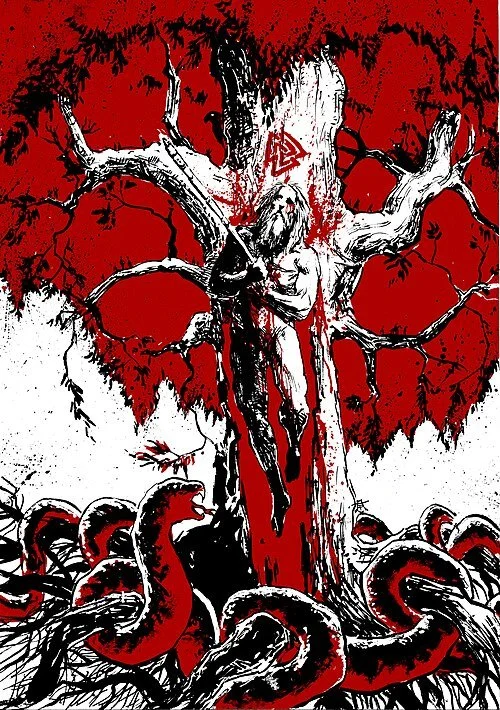
Odin yggdrasil.jpg by Kim Diaz Holm, used under CC BY 4.0.
In the Viking Age, seiðr (sorcery) was seen as deeply suspect. It was often considered immasculine and taboo for a man, let alone a warrior-patriarch. Odin, however, was a power-addict who didn't care about social optics.
He didn't seek wisdom, he hoarded it.
The Self-Sacrifice: He hung himself from the world tree, Yggdrasil, for nine nights. He pierced himself with his own spear as a sacrifice to… himself. He didn't do this for humanity or to redeem the world. He did it as a transaction to gain the secret of the Runes (hitherto invisible to both mortals and gods).
The Gain: The power of the Runes afforded unprecedented healing, knowledge, and power through spells.
The Price of an Eye: He traded his eye for a drink from Mímir’s well. This is often framed as "sacrifice for knowledge," but in the grander narrative sense, it’s the behavior of a man who will mutilate himself, and by extension the world, just to get an edge on his competitors.
Really makes you wonder, if all this is for the pursuit of survival, what state would his body be left in by the end of it?
The Blood Brother and the Fall Guy
History’s victors have done a spectacular job of making Loki the biblical snake of Norse legend. But let’s look at the ledger: Odin entered a blood-brotherhood with Loki knowing exactly who and what the trickster was.
Odin used Loki as a “fixer.” When the gods needed a wall built or a giant dealt with through deception, Odin looked the other way. He kept the snake close until the snake became a liability for his own survival. Their relationship wasn't a tragedy of brotherhood, it was a cold-blooded partnership between two sharks where one happened to have a better PR department.
Unlike Odin, Loki made no qualms about his deceptions. He was a true cunning rogue, with no feign for nobility. The devil you know…
The Gatekeeper of Poetry
“Who so controls the narrative controls history.”

Causing innocent deaths, seducing guardians, and hogging all the mead. Talk about dead-beat all-daddy.
Even the story of the "Mead of Poetry" reveals his true nature. Odin stole the mead, not to bring inspiration to the masses, but to keep it for himself and his chosen few. He is a god of secrets, and by definition, secrets are exclusionary. As the ultimate gatekeeper, ensuring that the power of word and song remains a divine weapon rather than a human gift must have been a no brainer. Allegedly, it took him three days to drink it all.
They say the leftover mead that dropped from his mouth as he fled Suttungr is the reason we have bad poetry. Guess modern artists really owe Odin a beer (he’s certainly had enough mead).
Seizing the power of word and song was as poignant then as it is today. Who so controls the narrative controls history.
Final Thoughts: The Cost of Survival
Readjusting the lens through which we view Odin reveals a desperate strategist who viewed the Nine Realms as a chessboard, and humanity’s mightiest warriors as mere pawns. While a god like Ares may have bled with his soldiers, Odin is the general who stays in the tent, counting the bodies, checking his ledger, and maybe even slurping down mead.
As we traverse the modern landscape of “heroic” mythology, it’s worth asking: do we admire Odin because he’s good, or because we’ve been gaslit by his own ravens, Huginn and Muninn? In the end, the All-Father isn't here to tuck you in at night. He’s here to make sure you’re sharp enough to die for him when the wolves finally come.
Got a jab to take at me for my claims? Maybe your a loyal son/daughter, looking for daddy’s praise? Hit me with your best shot in the comments. Winner buys the mead…
