What is the History of Lycanthropy?
Written by: Taylor Holmes
Arguably, one of the world’s most popular supernatural creatures, the werewolf, is pretty well-known. But most don’t know about its ancient origins. Both in historical accounts and mythology, the werewolf has a storied past…
Where did the werewolf legend originate?
Some of the earliest known accounts of men turning into a wolves come from ancient Mesopotamia and Greece. Fables like the Epic of Gilgamesh (2100 BC) and the story of King Lycaon (710 BC), involve a man being turned into a wolfen form.
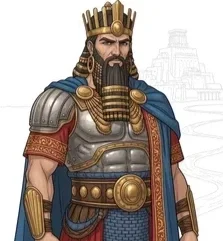
Good ol’ Gilgamesh, just trying to dodge toxic relationships and pursue immortality. Aren’t we all, though?
In the Epic of Gilgamesh, the temperamental Mesopotamian goddess Ishtar is denied affections from Gilgamesh, King of Uruk. He cites her history of… spurning her lovers. One such case is a loyal shepherd whom she turns into a wolf, and is subsequently torn apart by his sons and hounds. Some believe this may have been inspiration for the myth of Actaeon, a hunter whom chanced upon Artemis (goddess of the wilds and hunt) bathing, was turned into a stag, and torn apart by his hounds.
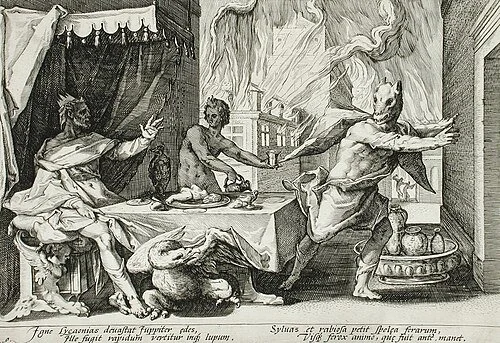
Zeus: This meat tastes like a child.
Lycaon: How do you know what children taste like?
Zeus: Consider yourself cursed.
In the case of King Lycaon, the transformation was a little more… earned. He was metamorphosed into (you guessed it) a wolf by Zeus for attempting to serve him human flesh as an offering. Separately, a curse on the Clan of Anthus, caused them to transform into a wolves for 9 years. Were they to abstain from human flesh for their lupine imprisonment, they would be returned to human form.
Fast forward to the 13th century, the Völsunga saga depicts Sigmund and Sinfjötli, fleeing from king Siggeir. They stumble across some men sleeping under wolf hides. They don the skins, and find themselves bound to a lupine form. They fight with more ferocity than any human, yet retain their intelligence, until they eventually find a way to shed the pelt and destroy them.
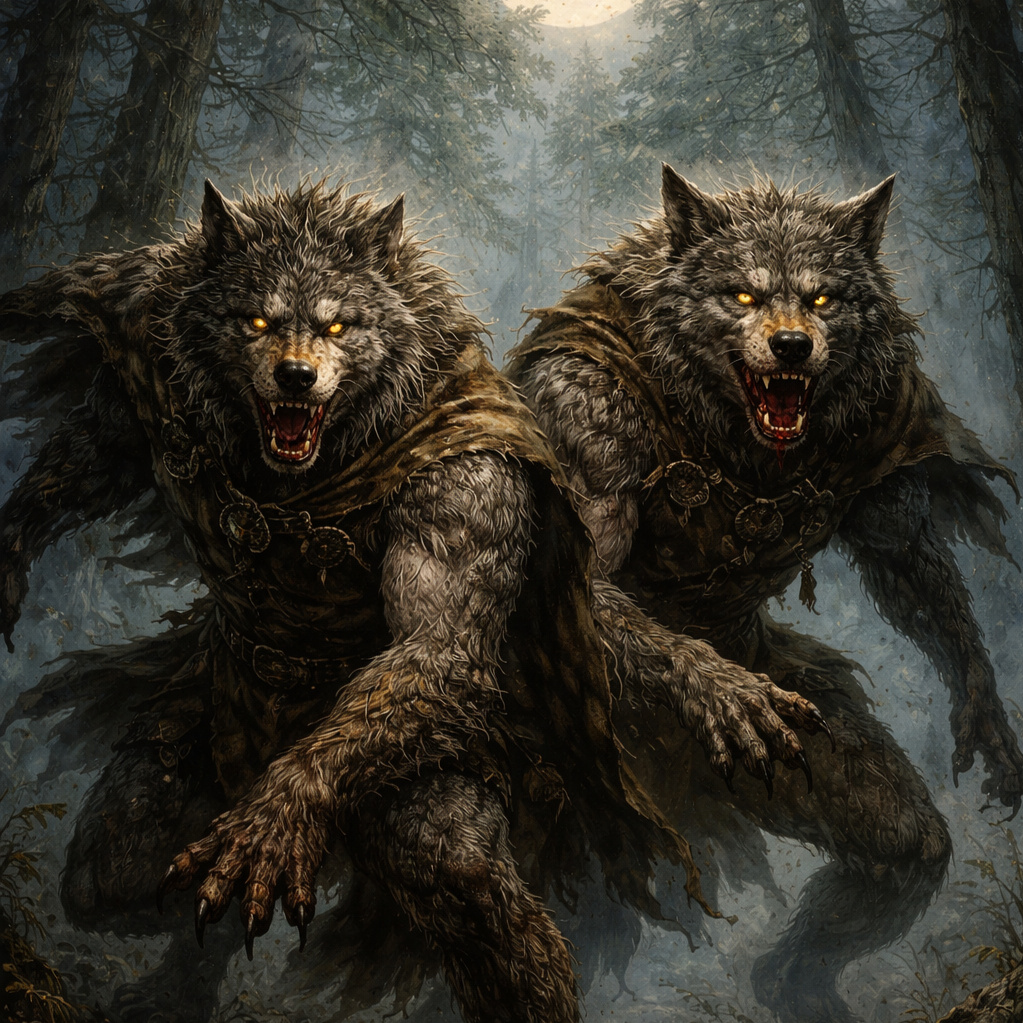
Sigmund and Sinfjötli in their lupine forms, inspired by the Völsunga saga—Norse mythic warriors transformed into fearsome werewolves beneath a moonlit forest sky.
In Native American folklore, many creatures are likened to a werewolf. In French influenced part of Canada and Louisiana, they borrow from the loup-garou. The Navajo peoples have the harbinger of ill-omen, the skinwalker, or for the Algonquian peoples, the wendigo. All of which are creatures of sacrilege, terror, or rapaciousness, respectively. While similar in concept, the skinwalker and wendigo are both distinctly different entities from the European “curse” model.
The Navajo skinwalker is the perverted antithesis to a shaman. Where one should bring healing and peace, they bring only death and evil through their sorcerous means and search for power.
The Algonquian wendigo is a malevolent spirit that corrupts greedy, selfish men. Somewhat similar to a possession, the victims themselves are rarely innocents.
Non-Mythological Accounts
But what about more realistic accounts? What about turning with intention?
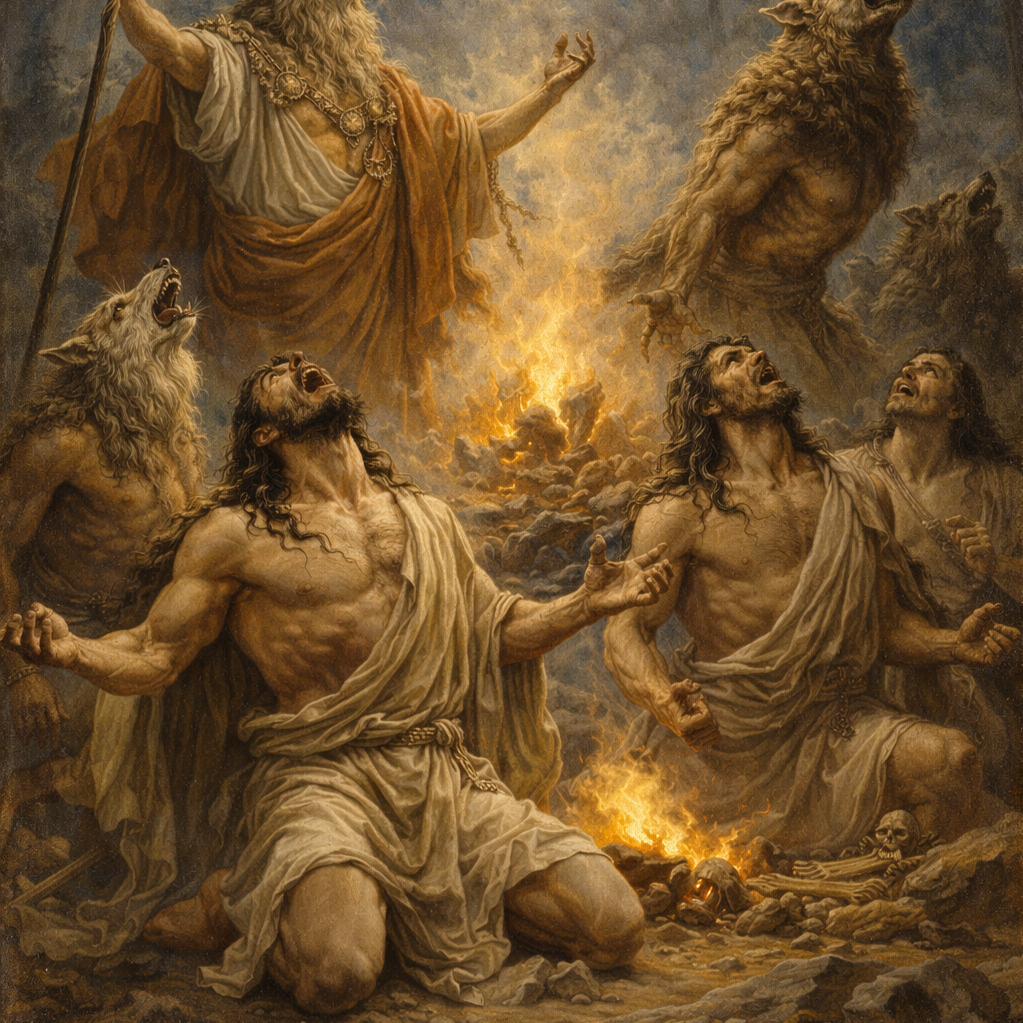
An artistic rendition, ancient Lycanthropy of the Neuri Tribe, Inspired by Herodotus’ accounts
In Scythia (modern Ukraine-Russia-Belarus border region) the Neuri tribe were seen as sorcerers by their neighbours. Herodotus, the Greek historian (425 BC) described ritualistic transformations into wolves for several days every year.
Similar in essence, the Nootka peoples of Vancouver Island to this day have rituals that embody wolfen spirits. Whether they truly transform, only they can say.
Much further down the line, from the 15th to the 17th centuries, there were many European wolf trials…
Pierre Burgot and Michel Verdun (1521): Two French shepherds who confessed to receiving a magic ointment from "men in black" that allowed them to transform, resulting in their execution.
Gilles Garnier (1573): Known as the "Hermit of Dole," Garnier was burned at the stake in France after admitting to the cannibalistic murder of children while in wolf form.
Peter Stumpp (1589): Perhaps the most infamous, this German farmer was executed near Cologne after confessing—under extreme torture—to killing 16 people while using a "magic belt" provided by the Devil.
Thiess of Kaltenbrun (1692): In a rare outlier, an 80-year-old man in Livonia (modern-day Estonia/Latvia) claimed to be a "Hound of God," arguing that he and other werewolves descended into Hell three times a year to battle witches and ensure a good harvest.
Were these cases, and the many others like them, simply deluded lunatics (pun intended) giving honest werewolves a bad name? Were they true, lupine legends? How does all of this fit into modern times? I just had to ask…
Lycanthropy and You
Modern takes on werewolves have brought them out of the shadows, quite literally. Just a few decades ago, they were still the object of fear and horror, but have since become enigmatic, sexy, and heroic. Where did this change come from?
Reasonably so, the werewolf has become a hot-topic in Books, TV, and movies. From the gothic horror, The Wolfman (1941) to Jacob from Twilight (2008) is a huge leap. What happened?
Simply put, the plight of lycanthropy went from being about the external monster to themes of psychological struggles. The monster within, so to speak. This shift made the terrifying monster to be more relatable. A poor, cursed innocent who struggles to be good, despite their affliction. Strangely, that story isn’t so new. Just like Gilgamesh’s unfortunate shepherd, Lycaon’s fate, and Sigmund and Sinfjötli’s unintended berserker state, modern werewolves struggle against their fate. Doomed to play that role. Luckily for them, they’re cool now.
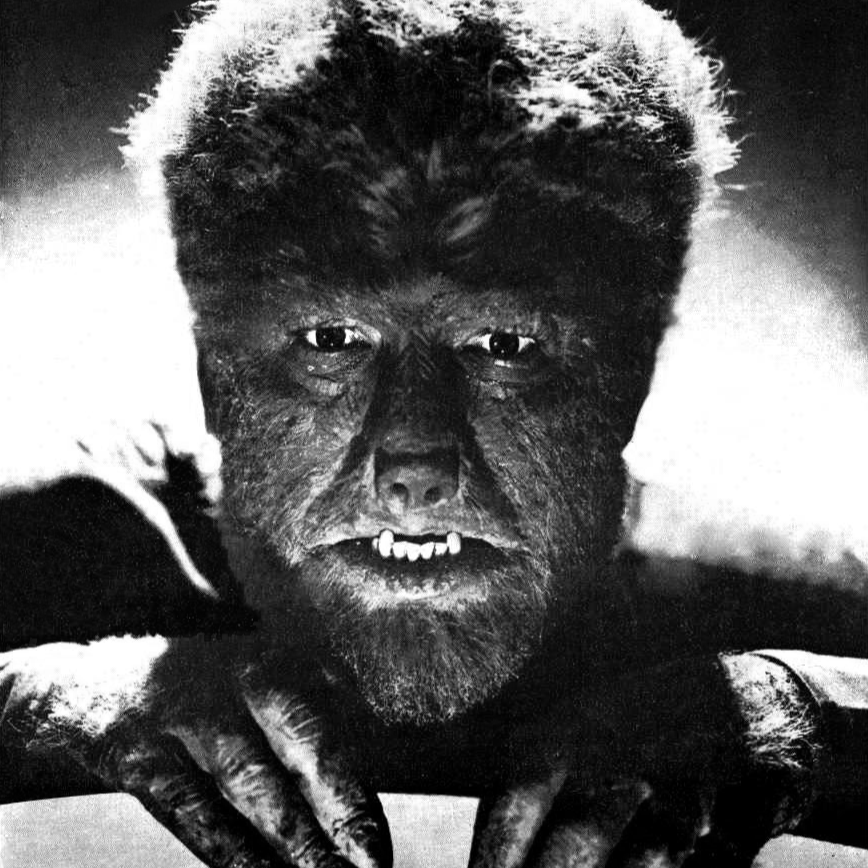
Sorry Lon, not looking so enigmatic, sexy, and/or heroic…
Despite their rise in popularity and affections in the public eye, werewolves are still very much a beat of terror. In cases of clinical lycanthropy, a psychiatric phenomenon, patients may genuinely believe/display animalistic behaviours and tendencies. Often enough, this comes at harm to both themselves and others. But it doesn’t really address the elephant in the room… Are there real werewolves out there? Surely it can’t be a simple coincidence that separated cultures spanning thousands of years have developed the conceptual identity of werewolves, often with the same theme, an unwanted curse.
All that and we haven’t even touched France’s Beast of Gévaudan, from the 1760s and its death at the hands of Jean Chastel (spins on this historical event helped spur the silver bullets theory). The closest evidence we have to a true werewolf is this horrific historical beast. But that’s a story for another time…
Maybe one day the truth will come out for good. Until that point, just in case, I’d like to stay in the good graces of our furry friends… lest I come to mind when they feel peckish.
Find out more info on wendigos and werewolves!
Got a bone to pick with my details? Something I said hackle your pelt? Leave a comment and cure this curse!