L'Hôtel Raconteurs
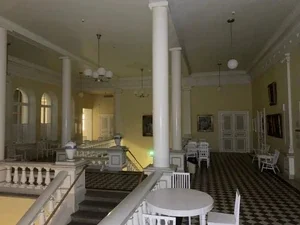
There is a place, an intangible space that’s believed to be within the “collective consciousness” of humankind. This transitory mindscape has been dubbed “L'Hôtel Raconteurs” by those who discovered it.
In this case study we will examine the history of L'Hôtel Raconteurs; the alleged procedure used to reach it; its purpose, outcomes, reagents, and steps; and its place in the modern world.
Computer generated image as to what L'Hôtel Raconteurs may look like, according to observers’ descriptions.
Contents
History
The Procedure
The Steps
Modern Trials and Evidence
Footnotes
History
In the early 1950’s, a Quebecois think-tank happened to stumble across a perfect storm of psychological experiments that resulted in the discovery of L'Hôtel Raconteurs. In an effort to treat excessive trauma in those who had witnessed and/or suffered the horrific events of World War 2 (specifically, the Normandy Massacres), a strange sort of "ritual" was born.
Upon its first successful implementation, it was believed that a key part of the psyche had been reached in one Jacques Tremblay. While being subjected to (what are now considered) unethical mental health experiments, Jacques “retreated” to a place deep in his mind, and appeared to be in a catatonic state.
Upon returning to consciousness, Jacques reported being “transported” to a grand hotel. The lobby was intricate, with paintings and “futuristic” light fixtures. The alabaster furnishings were described poignantly as “...simplistic, yet unnerving…” It was also mentioned that the lighting was “improper," as though it glared at the observer from the finely polished pillars regardless of the angle they were approached from.
According to Jacques' account, there was a grand divided staircase and several doors, accompanied by some meager furnishings (carpeting, chairs, tables), the most peculiar of which being paintings on the walls that were "...familiar, yet unrecognizable." The more time he spent in this “lobby” the more a feeling of terror grew, as if he wasn’t wanted there.¹ Jacques proceeded through one of the doorways, in which he was met with a seemingly endless hallway of doors. They all appeared to contain memories, or moments of his life in which he felt anxiety, fear, or anger.²
Upon choosing a door, Jacques claimed to have “re-lived” the moment that, while in captivity, the 12th SS Panzer Division began to murder Canadian prisoners of war. According to his account, he “changed the moment” by not speaking, and keeping his head down (a distinct contrast to the behaviour he claimed to have previously exhibited during the event, in which he swore and screamed at a young German soldier, who gouged out his left eye).³
Due to this alleged change to the memory, Jacques claimed that his left eyeball was saved, and remained intact.
Following this experiment, Jacques behaviour and outlook on life appeared to have significantly improved.
Shortly before the end of his life, in the year 1988, a drawing of Jacques’ was found that resembles the descriptions of L'Hôtel Raconteurs, given by all who’ve witnessed it.
The researchers tirelessly attempted to mimic the conditions that led to this alleged mindscape, ultimately resulting in the death of at least one veteran.⁴
Eventually, the researchers found the methods necessary to recreate the circumstances that led to the hotel of memories that Jacques reached. The space itself was dubbed “L'Hôtel Raconteurs," or "The Storytellers' Hotel," by the researchers.
The Procedure
Shortly before the end of his life, in the year 1988, a drawing of Jacques’ was found that resembles the descriptions of L'Hôtel Raconteurs, given by all who’ve witnessed it.
The necessary reagents for a participant to reach L'Hôtel Raconteurs are as follows:
At least one additional person (dubbed the facilitator), who is to subject the participant to the procedure’s more difficult aspects, and encourage the proper facilitation of the procedure's objectives.
A comfortable, isolated environment (to prevent foreign involvement, or external stimuli).
Relevant (to the participant) emotion evoking and trauma inducing forms of stimulation.
Powerful sedatives. Propofol appears to work effectively, but opium and laudanum have been used with varied results.⁵
An analog form of time management (wristwatch, pocketwatch, etc.). Items that run on batteries may work, but are discouraged. Winding mechanisms are strongly advised.⁶
Any kind of strong adhesive tape, rope, heavy fabric, or binding that may be used to restrain an individual.
Primarily, the ritual requires that the participant (henceforth referred to as “observer”) be the victim of some kind of traumatic experience. The significance and impact of the trauma appears to differ, but must be considered a burden of substantial weight to the observer.
The Steps
The observer must be in the aforementioned semi-hermetic environment, so as to maintain the integrity of the procedure.
The time management device must be fully wound (or if electronic, fully charged / on fresh batteries) and fastened to the observer’s hand with restraints (if the observer has no hands, it must be fastened to a part of their body they use to facilitate basic daily chores including, but not exclusive to, the mouth).
(Optional) Using restraints, ensure the observer cannot flee or avoid the triggers being used. The observer’s consent and willingness are helpful, but not necessary.
Expose the observer to (relevant) trauma until they appear to become “numb” or reach an unresponsive stupor. This step appears to have the highest risk of failure, and has had poor long-term results in those who do not reach a state of catatonia.⁷
At this point, remove the time management device from the observer’s hand. The device must be inspected, to see if it’s still operational (the actual accuracy of the device doesn’t appear to matter). If the device is intact and working, proceed to step 6. If the device is damaged, broken, or fails to continue its designated purpose, abort the procedure immediately, and attempt to revive the individual.
Administer the sedatives / anesthetics.
If all of the steps are appropriately followed, the observer may find themselves in L'Hôtel Raconteurs. Once there, they may seek out a moment of their life in which they have suffered a traumatic event (or an event that led to a traumatic event) and potentially change the outcome.
The results are unquantifiable, as it appears that reality will "mold" to the changes made by the individual. Some debate exists over whether people relive false memories, meaning there is no true impact to the ritual (aside from potential treatment for trauma, which is massively overshadowed by the risk involved). In select cases, other individuals who may have been affected by the altered memory, directly or otherwise, have reported strange feelings of nostalgia, déjà-vu, or vague premonitions regarding the events of the memory in question.
The hotel itself appears to have some level of will, sentience, and control that it exerts over itself and the observer(s). It will try to encourage the observer to face the particular trauma that’s used as the foundation of the ritual. The hotel is also known to make the observer considerably more uncomfortable the longer they spend inside of it. It’s theorized that if a decision is not made in a prompt amount of time (3 hours, within the hotel, the real time appears to vary greatly) an individual may not wake up, and remain in a catatonic stupor indefinitely.⁸,⁹
Modern Trials and Evidence
A well-worn document made its way across the internet in which recent trials were attempted, but the core document itself has either faded into obscurity, been removed, or vanished altogether. Until this report, no consistent compilation of the details has been released as a whole, or shared with the public.
The document in question details the events of a psychologist and self described ritologist named Rafael Levant, attempting the ritual four times with a small group of largely uninformed volunteers, of whom half were hand picked to be observers, and the other half facilitators. His experiments themselves were dual in purpose; to explore and confirm the validity of the ritual, and to test the boundaries of human capabilities when pushed to commit potentially dangerous actions against other human beings (under the direction of a superior authority)¹⁰.
Rafael's proposed experiments are the closest concrete evidence we have to the ritual's legitimacy (barring the early tests, from the aforementioned think tank). Only fragments and vague details from a single source were ever found, highlighting the dubious nature of the procedure, and L'Hôtel Raconteurs itself.
The following document is the result of thousands of hours of concerted efforts to…
A. Screen the validity of relevant information.
B. Ensure linguistic background checks for consistency.
C. Research all individuals involved, and their roles.
D. Selectively omit irrelevant or sensitive data that may put people or organizations at risk.
F. Compile the appropriately vetted data for public release and consumption.
The document reads as follows:
"There is no cure. No cure for madness, sadness, trauma or harm. The only balm is time, and he who masters time, masters the world.
I was molested as a child, by a family friend. I wish I could say it was only me, but my poor sister suffered too. It's hard to say which one of us handled it worse in the long run, considering she killed herself at thirteen. It's a terrible thing to happen to anyone. It weighs on you, weighs on me still, though I expect everyone handles their pain differently.
My pain was handled by my family poorly, my therapist admirably, and narcotics sublimely. Once I believed I'd reached rock bottom, living a terrible life that I convinced myself I had no power over, I was invited to take part in a study. The study itself offered anywhere between three to five thousand dollars compensation, depending on the length and results of the study.
For the first time I could remember, I felt empowered, capable of making a change, naïve as it was. I felt obligated to myself to make a change, take a step towards healing. I didn't know the intention of the study until I'd agreed, but I suppose if I knew, I'd have accepted without hesitation. Had I known where I would ultimately end up, I'd be in the same place I am now, running from my life.
When I first met Doctor Levant, he gave me and the rest of the study's group, seemingly random and confusing tests. As the tests went on and the questions grew more disturbing and obscure, the group shrank significantly. Whether due to discomfort or "failing" the tests, what was something around thirty people dwindled to only five. We then proceeded to what he referred to as the "ritual" stage.
Everyone who had succeeded, or perhaps simply persevered, was subject to gratuitous torment. An elderly Middle-Eastern woman named Sarvy was subjected to gruesome war footage. She was the lone survivor of a drone strike on her village. A young lady, named Evelyn, was forced to watch staged violent gang-rapes. You can probably guess what her trauma was. Every one of them was forced to witness gruesome acts that were somehow relevant to horrible things they'd endured. I know this, because Doctor Levant made me watch. Just like I was forced to watch what happened to my poor little sister, by that fiend, so many years ago.
I only found out afterwards that Doctor Levant's experiments were mostly radical successes. Aside from a middle-aged man named Henry, who never "entered the hotel," everyone else not only lived, they healed. Unfortunately in Henry’s case, he took the life of one of the experiment’s facilitators, then his own.
By the time I learned about the successes, it was too late. I was bound to complete the experiment. Somehow, my trial, my ritual, superseded theirs. Not only did I commit the gravest of sins, but I robbed four people of recovery; of the ability to heal and move on. Whether selfishness, passion, or ignorance fueled my motivations in the end, I truly couldn't say.
When my turn came, to sit in that chair, I found a second person fastened behind me. I didn't know who or why until I found myself in that sterile hellscape of a hotel. In contrast to what others had told me to expect, I wasn't alone in that lobby. Weeping like a child was Doctor Levant himself.
The insides of the building were not what they were supposed to be, he told me. The walls were empty, void of windows. There were no lights, no paintings, no furniture… he knew something was wrong. Doctor Levant was filled with dread, and was clearly apprehensive about approaching any door.
"Luckily for us," he told me, "some of our memories had to have retained their individuality."
It turned out that the doctor had some skeletons in his own closet. I knew because I rattled the bones, and was shaken to my very core.
The first door was a horrific mash of my first day of third grade, in which I wet myself and my teacher spanked me in front of the class, and something else… something I didn't recognize. It was clear that Levant did, as he slammed the door faster than I could assess the environment.
The good doctor began to run down the halls, as if he was derangedly scouring for a particular memory that he knew wouldn't be there. I was abandoned. Left to wade through the mess he left me in.
After what my watch told me was an hour, the hotel began to… resist. Doors flung open as I walked by, and gusty winds blew from the portals, as if desperately trying to suck me into a memory. From what I saw, each memory was more warped and terrible than the last.
Having lost Doctor Levant, I was forced to make my way through the distorted and melded scenes of chaotic trauma. My fear grew as I was unable to commit myself to any entrance. Slowly, my options dwindled, bit by bit. The horrors I've faced in my life all pale in comparison to mere glimpses of the twisted hotel's corridors, occupied only by pain and anguish.
The hotel's toll began to sink in. Constant forlorn and piercing howls echoed the halls. The memories of Doctor Levant began to become my own. I felt them, knew them. My sense of self began to slip away, and reality became true horror. How long was I there? Was Doctor Levant still inside too? Am I actually him, and have I been all along?
That was when my maddened musings were abruptly halted. A memory, one I knew was not mine at all, appeared at the end of a hallway. I felt Doctor Levant's exact emotions from the moment. The terror, the agony… I spectated for a few minutes, bearing witness to what at first looked like a group of children playing innocently. Upon further realization, it was Doctor Levant as a small child, no older than six, being gruesomely tortured by some other children. The streets and buildings looked old, and many people passed by, ignoring his cries as they burned his flesh and mutilated his genitals. They howled and screamed in some foreign language that I couldn't recognize. Finally, I overcame my hesitance, and stepped through the doorway.
I just wanted out, you see. I wanted out of the hotel, out of the experiment. I wanted it all gone, and for no one to experience the mind breaking meta-reality that this transient space had borne.
As I stepped through the portal, the hotel's fading walls and cacophonous wails finally released me. The children ceased the torment and looked at me. At first, they seemed uncertain, perplexed. They yelled to me in their unrecognizable tongue. I didn't know their words, but I knew what they were saying. They wanted me to fuck off.
First, I grabbed the biggest child by the neck, and began to ram my fist into his face, over and over. Once I started, I couldn't stop. They began to scream, and some tried to flee. I grabbed a young girl's golden curls, and pulled her back, kicking in a kneecap. She screamed as she crumpled to the ground like a Slinky. At this point, passersby began to finally take notice, as the other children fled.
People were shouting behind me, but I knew I had to end this memory, end the trauma. It was my only way back to reality, right?
I stepped forward to the whimpering and terrified child, the boy who would have been a doctor. Would have, if I hadn't stomped on his small and fragile throat, ending his lifelong struggle before it could ever take root.
When I woke, I found myself in a dark complex, hardly recognizable from the lab that hosted the malign experiments. Since that time, that stay in that terrible place, I've been a man unhinged. Hiding from the truths that mankind should never pursue. I only pray that my words serve as a testament to what life and pain, should and shouldn't be.
It is important to note, much like all other details pertaining to the enigmatic hotel, nothing in this document can legitimately be corroborated. As such, there is no evidence that a "Doctor Rafael Levant" ever existed or worked in the western world.
In closing, a cure for the ails of a tortured spirit would be a "Holy Grail,” a universally sought panacea, if it were true. But even if so, would such a price be worth paying? That remains to be seen.
Footnotes
The observer claimed to have been overcome by discomfort and uneasiness, as though the place itself was alive, and did not want him there. It encouraged any and all attempts to leave, and appeared to distort, make disquieting noises, and cause hallucinations the longer one stayed. The latter most appeared to become distinctly terrifying.
The moments witnessed before a memory was ultimately chosen: A scene of significant abuse at the hands of his father, being scolded by his aunt for having wet the bed as a child, and being ridiculed in school.
There is no existing record or evidence of Jacques having lost an eye, or suffering any significant mutilation during the Normandy Massacre.
Due to excessive overdose of sedatives.
Laudanum has only successfully been used in one known case.
The use of digital watches has proven unreliable in at least three cases.
Subjects who have undergone the excessive traumatic exposure, but not reached a state of catatonia have an increased risk of developing mental health disorders and attempting suicide by 150% and 600% respectively, compared to the North American average.
In several cases, individuals have failed to regain consciousness or awareness of their situation. They end up trapped in a permanent vegetative state until their ultimate demise.
Individuals have reported that as the time management device (that they find themselves with, inside the hotel) proceeds towards the 3 hour mark, doors begin to gradually disappear, leaving not but blank yellow walls behind.
Similar to the 1961 Milgram experiment.